Cherry Springs State Park Stargazing Guide
Where and When to Stargaze
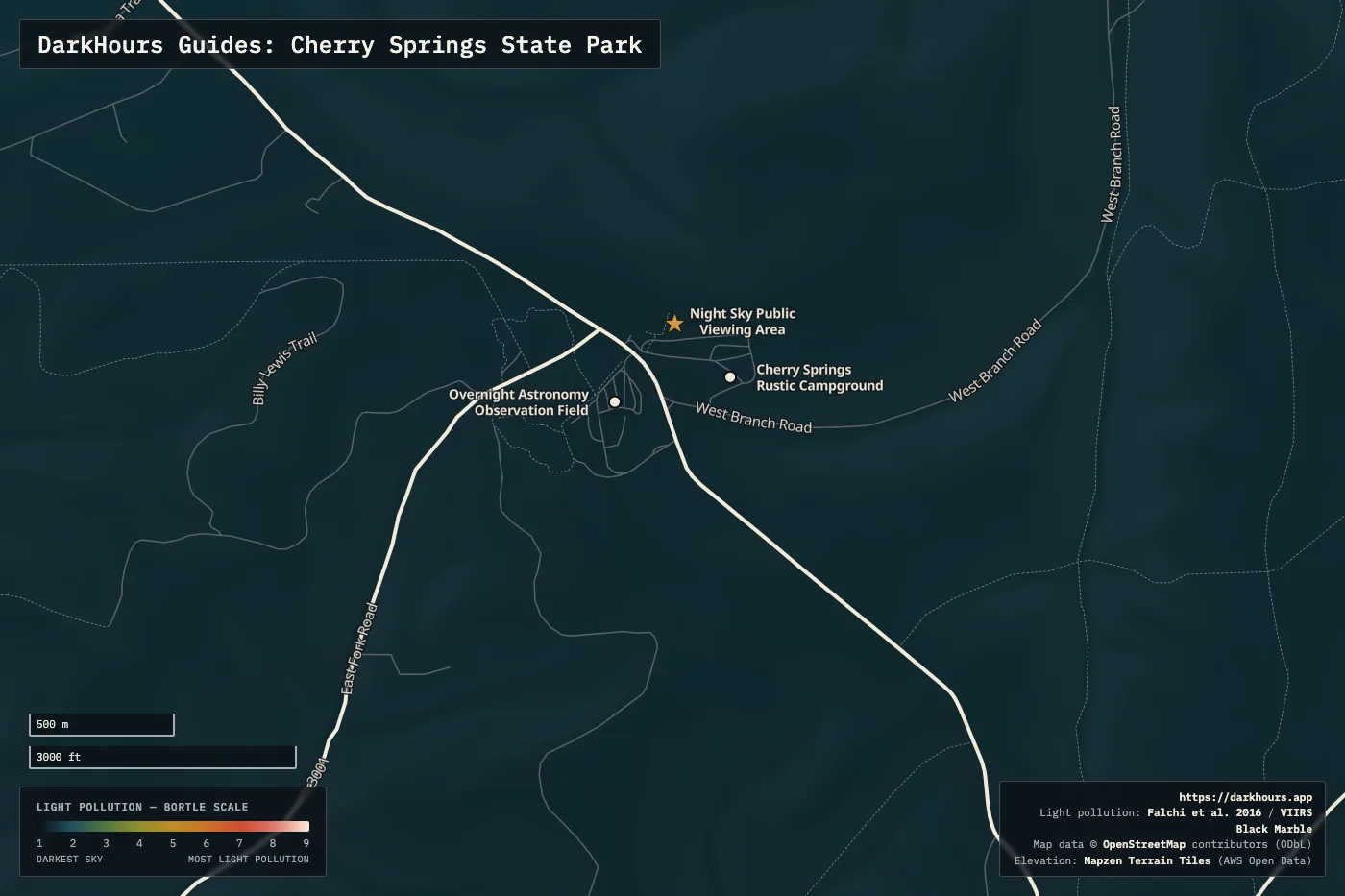
- Where: The Night Sky Public Viewing Area north of PA 44 is meant for a few hours of stargazing and doesn't require registration. If you have your own equipment and want to stay all night, register and pay the user fee for the Overnight Astronomy Observation Field.
- When: The Milky Way core is visible from February through October and is highest in June, when it gets about 19° above the southern horizon. DarkSky International puts the number of nights with ideal observing conditions at 60 to 85 a year. Give yourself more than one night if you can.
- Moon: Go near the new moon. The outlook table below shows the best night in each month.
- Programs: When the weather allows, a park educator or guest speaker leads public stargazing programs at the viewing area and amphitheater. The park also hosts two large star parties every year.
Location Overview
Cherry Springs State Park covers 82 acres in Potter County in north-central Pennsylvania and is surrounded by the 262,000-acre Susquehannock State Forest. According to DCNR, the park stays dark because it sits on top of a 2,300-foot mountain in mostly undeveloped forest, and the towns nearby are down in valleys where the ridges block their light. Pennsylvania made it the state's first Dark Sky Park in 2000. DarkSky International certified it as an International Dark Sky Park in 2008, and DCNR says it was the second one in the world.
This page's reference point is the Night Sky Public Viewing Area north of PA 44, where the park holds its public stargazing programs. The sky there rates Bortle 2 on the Bortle scale.
The nearest light domes are 50 miles or more away. The brightest part of the horizon is to the southeast, toward Williamsport at 51 miles. Northwest is the next brightest, with Jamestown, NY, 79 miles away and Buffalo at 101 miles. The darkest directions are west and east. The sky due south, toward Bellefonte 56 miles away, is brighter than the west and east but well short of the southeast.
At 41.7° north, the Milky Way core never gets high. It is above the horizon from February through October and reaches its highest point in June, at about 19° above the southern horizon. The core rises in the southeast over the brightest part of this sky and is highest when it crosses due south, where the sky is darker. Photos of the core will come out better near that crossing than while it is still low in the southeast.
Night Sky & Weather Conditions
The park is on a mountaintop on the Allegheny Plateau. DCNR says the weather "generally tends to be on the cool side" and "can also be damp," and recommends proper clothing and footwear. A dew heater or dew shield for your optics is a good idea.
Cloud cover limits how often you can observe here. DarkSky International's certification page counts 60 to 85 nights a year with ideal observing conditions. The park's stargazing page links to a Clear Sky Chart. If you're traveling a long way, plan for an extra night in case the first one is cloudy.
The park is open every day of the year. The Rustic Campground is open from mid-April through late October. Winter brings snow and cold to the roads up to the ridge. Check the NWS State College forecast for Potter County before you go.
Tonight at Cherry Springs State Park
Six-Month Moon & Darkness Outlook
| Month | Mean dark hours | Best night | Meteor showers |
|---|---|---|---|
| October 2026 | 4.9 h | Oct 19 · 5.5/10 | Orionids |
| November 2026 | 5.8 h | Nov 7 · 9.8/10 | Northern Taurids (favourable), Southern Taurids, Leonids |
| December 2026 | 6.2 h | Dec 6 · 9.8/10 | Geminids (favourable), Ursids |
| January 2027 | 6.2 h | Jan 4 · 9.8/10 | Quadrantids |
| February 2027 | 5.4 h | Feb 2 · 9.8/10 | — |
| March 2027 | 4.9 h | Mar 4 · 9.8/10 | — |
Dark Sky Nearby
No significantly darker sky found within 60 mi.
Scouting & Foregrounds
- Night Sky Public Viewing Area — This page's reference point, and the easiest place to start on a first visit. It has public parking, restrooms, waysides, and a walkway to an amphitheater that DCNR describes as shielded from passing vehicle lights. You don't need to register. DCNR intends it for stargazing of a few hours or less, and overnight stays aren't permitted. White light is allowed here, but DCNR recommends a red filter, asks that lights be pointed down, and says anyone using white light during a public program will be asked to turn it off. Pets are prohibited, and alcohol is on DCNR's list of things not to bring.
- Overnight Astronomy Observation Field — This field is for observers with their own equipment who plan to stay all night. DCNR requires a permit and a user fee before you set up. You register at the Contact Station next to the Visitor Parking Lot and display the permit on your dashboard. White light is prohibited on the field, and every light, including interior vehicle lights, has to be red-filtered or fully shielded. To park on the field, arrive before dark. After dusk you park in the lot next to it and walk in. The field has a 360-degree view of the horizon, 120-volt outlets on RV-style pedestals for charging telescope batteries and laptops, Wi-Fi, and concrete telescope pads 4 to 6 feet across.
- Cherry Springs Rustic Campground — The campground has 30 non-electric sites and is open from the second Friday in April through the last weekend in October. DCNR suggests it for casual overnight stargazing and doesn't recommend it for serious observers. There are no lighting restrictions here, though DCNR recommends red filters on all lights and asks that campfires be kept small. Reservations go through the state park reservation system.
Logistics & Access
Cherry Springs is remote, and DCNR says most cell phones get no signal there. It asks visitors to download the park map before arriving, and it makes sense to download star charts and directions at the same time. A free local-use phone is at the camper check-in station, and directions to the nearest hospital, UPMC Cole in Coudersport, are posted on park bulletin boards. Questions go to the Lyman Run State Park office, which manages Cherry Springs.
The park is on PA 44 in Potter County, at 4639 Cherry Springs Road, Coudersport, PA 16915. It is a long drive from the nearest large cities, and staying overnight is easier than driving home after a late night. If it's your first visit, arrive while it's still light. The turn-off is on an unlit ridge road.
All of the park's lights are shielded red fixtures, and its overhead power lines are buried. On the overnight field, red light is required. In the public viewing area it is recommended. Bring a red headlamp or a red filter for your flashlight, and turn your phone screen down before dark.
The park hosts two large star parties each year, one of them the Black Forest Star Party, and each brings several hundred astronomers. The annual Woodsmen Show draws thousands of daytime visitors in early August. Check the park's events calendar and alerts before choosing a date.