Grand Canyon National Park Dark Sky Guide
Location Overview
Grand Canyon National Park spans 1.2 million acres of the Colorado Plateau in northern Arizona, preserving 277 miles of the Colorado River's gorge. This page covers the South Rim's Desert View Drive corridor: the developed, paved side of the park. Grandview Point, this page's reference, is a rim overlook along Desert View Drive (AZ-64 East) at 7,413 ft, with an open, unobstructed view into the canyon. The park earned provisional International Dark Sky Park status in 2016; full certification followed in June 2019 after a multi-year retrofit of more than 5,000 park light fixtures to dark-sky-friendly standards.
Night Sky & Weather Conditions
High desert plateau climate: the South Rim's 7,000+ ft elevation keeps nights meaningfully cooler than the canyon floor a mile below, where daytime highs regularly exceed those on the rim by 20-25°F. Arizona's summer monsoon (Jul-Sep) brings afternoon thunderstorms and cloud buildup most reliably; skies tend to clear again after sunset, but check the forecast before committing to a night out. Winter (Nov-Mar) can bring snow and icy sections along Desert View Drive — check road conditions before a winter-night drive. Light domes here read as effectively clear from every direction, with the sky's darkest point toward the north — among the most pristine readings of any site on this hub. Early June is the Milky Way core's best month: computed for a new-moon night, the core peaks around 25° above the southern horizon at roughly 1:20 AM local time, with the galactic arch sweeping northeast toward the Cygnus Star Cloud at 80°. From the South Rim, the core sits due south of the canyon itself, so framing both the core and the canyon in one shot means shooting toward the rim's south-facing overlooks rather than north across the gorge.
Tonight at Grand Canyon National Park
Six-Month Moon & Darkness Outlook
| Month | Mean dark hours | Best night | Meteor showers |
|---|---|---|---|
| August 2026 | 1.0 h | Aug 21 · 7.2/10 | — |
| September 2026 | 4.2 h | Sep 11 · 10.0/10 | — |
| October 2026 | 4.9 h | Oct 8 · 10.0/10 | Orionids |
| November 2026 | 5.7 h | Nov 6 · 10.0/10 | Northern Taurids (favourable), Southern Taurids, Leonids |
| December 2026 | 6.0 h | Dec 6 · 10.0/10 | Geminids (favourable), Ursids |
| January 2027 | 6.0 h | Jan 4 · 10.0/10 | Quadrantids |
| February 2027 | 6.4 h | Feb 3 · 10.0/10 | — |
Dark Sky Nearby
Already at Bortle 1 (SQM 22.1) — showing other Bortle 1 sites within 60 mi.
Scouting & Foregrounds
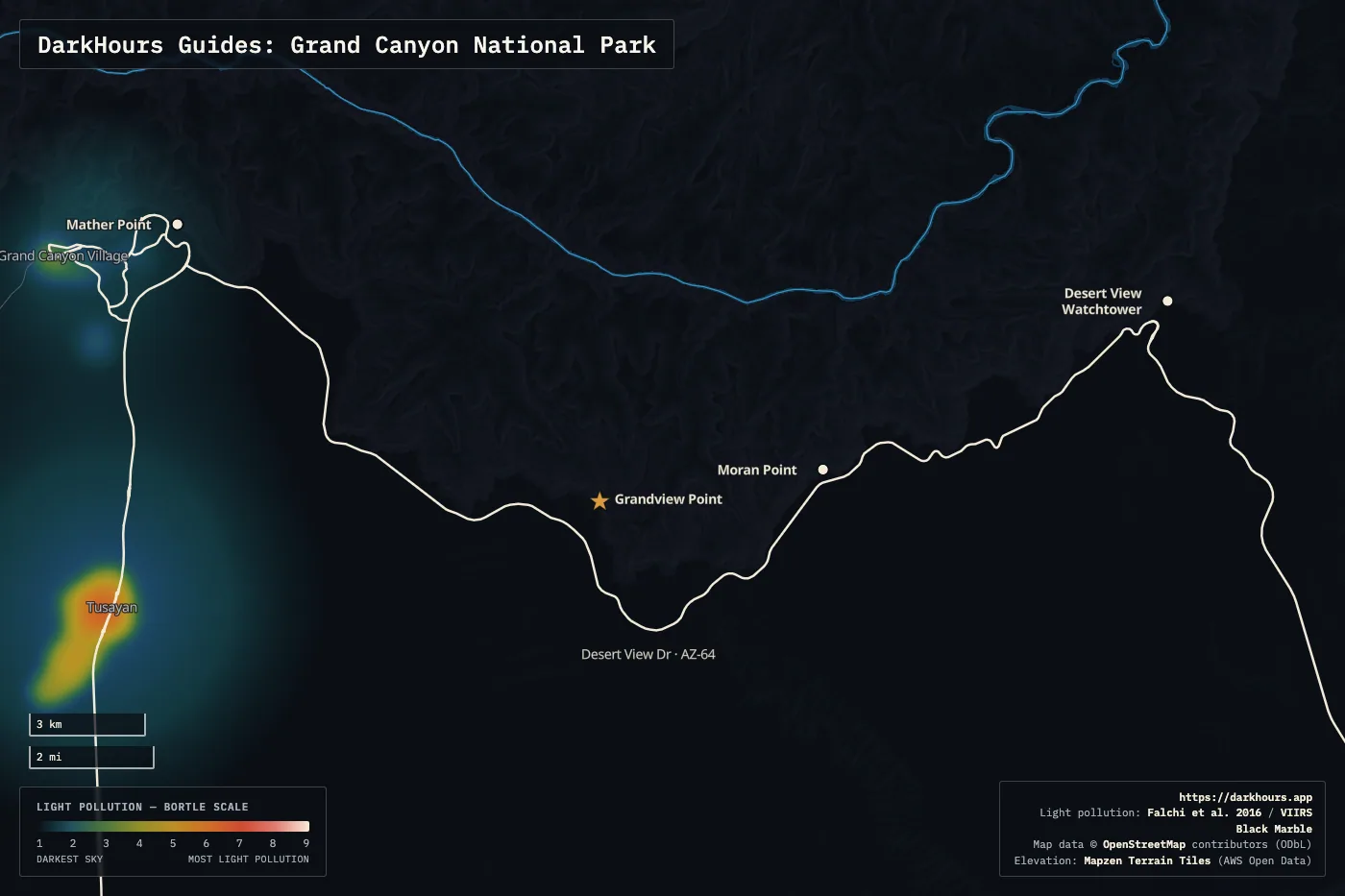
- Grandview Point — This page's reference coordinate, on Desert View Drive about 12 miles east of Grand Canyon Village. An open rim overlook with no guardrail-mounted structure breaking the skyline (the viewing area does have a short protective wall that is low enough to not break into a wide lens frame), making it a straightforward pick for wide-open canyon-and-sky framing. Historically the trailhead for the Grandview Trail down to Horseshoe Mesa, but the overlook itself does not require a hike to get to. Attempting to hike down the trail in total darkness is not recommended.
- Desert View Watchtower — About 9.6 miles east-northeast of Grandview Point, at the far end of Desert View Drive. A 70-foot stone tower designed by architect Mary Colter and completed in 1932, built to echo the ancestral Puebloan watchtowers found elsewhere on the Colorado Plateau. The National Park Service's night-sky guidance singles out the tower as an excellent foreground object for framing the Milky Way core from the South Rim. Desert View Watchtower shot from the north with the Milky Way core in the background is one of the most iconic night sky shots in the park. This area shares the same Bortle 1 sky as Grandview Point, but there can be some minor light bleed from various buildings like a restaurant, store, restrooms, and seasonal gas station in the Desert View complex. With the exception of the restrooms, all other buildings close before dark and usually keep minimal lights on.
- Moran Point — The closest neighboring overlook to Grandview Point, about 3.6 miles east along Desert View Drive. Named for Thomas Moran, the landscape painter whose canyon paintings helped build the case for the park's creation. Quieter than Grandview or Desert View, with the same open, unobstructed rim view.
- Mather Point — About 8.0 miles west-northwest of Grandview Point, directly behind the Grand Canyon Visitor Center in Grand Canyon Village — the park's main South Rim hub, and NPS's own pick for stargazing closest to lodging and services. Busier than the Desert View Drive overlooks given its location, but the least remote area in the park.
Logistics & Access
Grand Canyon's standard vehicle entrance pass for the South Rim is $35 for 7 consecutive days as of this writing — check the official fees page for the current rate. The park does not accept cash; entrance passes are credit/debit only. The South Rim is open 24 hours a day, and NPS guidance is that visitors may stargaze anywhere in the park at any time of night with no permit needed for roadside viewing at the overlooks above. Grand Canyon Village, near Mather Point, has the park's main concentration of lodging, dining, and services. The Desert View end of the drive, near the Watchtower, is more sparsely developed. Desert View Drive is a paved, two-lane road the entire distance from the village to Desert View. There are no unpaved sections or high-clearance requirements for any of the overlooks on this page, nor is hiking required to reach them as they're all easily reachable from their parking lots.
Watch for elk after dark. NPS's road-conditions page for Desert View Drive advises drivers to watch for deer, elk, and coyotes in the roadway. Rocky Mountain elk have been present on the South Rim since being introduced from Yellowstone in the 1910s–20s, and are most active during the August-to-early-winter rutting season — which overlaps the Milky Way core's own best viewing months above. Elk wander into parking areas and overlooks themselves, not just the road — NPS asks visitors to stay at least 100 feet away from elk generally. That's easy to forget when you're focused on a tripod and a dark viewfinder. Desert View Drive is not lit, and on a moonless night your headlights are the only light on the road. The surrounding areas outside the park are also dark. Avoid driving long distances at night. ADOT reports that wildlife-vehicle collisions cluster from sunset to sunup on rural roads. Consider staying inside the park or in the nearby town of Tusayan overnight. If you must drive, stay alert, and budget extra time. The same darkness that makes the sky worth the trip also makes a fast-moving animal or a sharp curve harder to spot.
Stay back from the rim, especially in the dark. NPS's own safety guidance calls for staying at least six feet from the edge at every overlook and never climbing over a railing or barrier where one exists. Night photography especially: don't back up without looking first where you're going.