Planning
Around late May, I started planning an astrophotography trip for the weekend of June 12. The waning crescent moon would rise late in the morning just before sunrise providing a full evening shooting window. Mid-June is prime Milky Way core season, with good weather across many regions. Having worked out the date, I needed to settle on a location. Because of my job, I’m able to fly standby to just about anywhere, as long as there’s room. Flying standby affords me a lot of flexibility, but it also requires it. I initially considered Sedona, AZ, one of my favorite locations, and where I first saw the Milky Way, but kept Moab, Joshua Tree, and Zion National Parks in my back pocket.
Two days out, the weather forecast models started calling for 100% cloud cover and rain for Sedona all weekend. The night before the trip, flights to Salt Lake and Las Vegas began booking up, but flights to LA had seats. It’d be a little hot at night, but Joshua Tree was it. Or so we thought.
Change of Plans
Very early Friday morning, walking into the airport, my wife and I realized the open seats we’d been counting on for LA had booked up overnight. Adaptability and planning pay off. This may sound corny, but I checked out my backup locations in the app I was developing to look up data for Sedona, AZ, Moab, UT, and Zion National Park. The DarkHours showed that Zion was the winner.
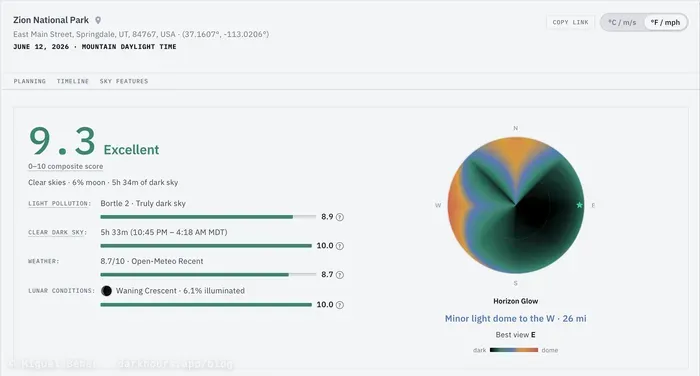
With Zion locked in, we pivoted back to Salt Lake, but by way of Cincinnati. From Salt Lake, we would fly south to St. George, UT, and then rent a car and drive about 90 minutes east to Zion. Everything lined up. We faced a longer travel day than originally planned, but we’d be driving into Zion by 7:00 PM local time. We had plenty of time to settle in before shooting. The rest of the trip went smoothly. St. George airport is small and well run. We were on the road about 10 minutes after landing. We picked up water and food in Hurricane, UT, on the way into Zion, and arrived at our cabin at Zion Mountain Ranch exactly on schedule. We ate dinner, rested a bit, and headed out to shoot around 10:00 PM.
The Two Nights
We had a rough idea of where we wanted to shoot. We hadn’t been able to scout beforehand, but noted a few spots on our drive in: a pull off at Checkerboard Mesa, another at Canyon Junction, and the parking lot of the Human History Museum. No night hikes without first doing them during the day.
We started at Checkerboard Mesa about 20 minutes prior to astronomical darkness. I love watching satellites zoom overhead in twilight as they catch the sun. Seeing them orbiting our planet reminds me of what we’re capable of creating and where we’re going. It’s why I added a satellite tracking feature to DarkHours. As the sky darkened, we began to see the Milky Way rising over one of the mountain peaks.
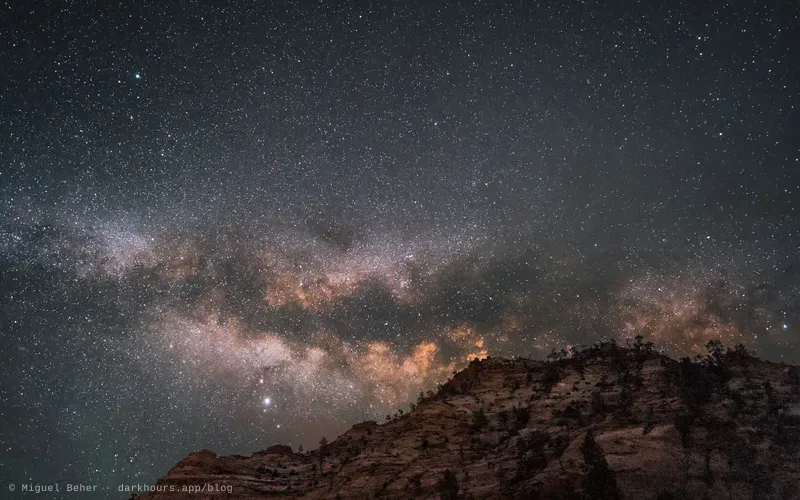
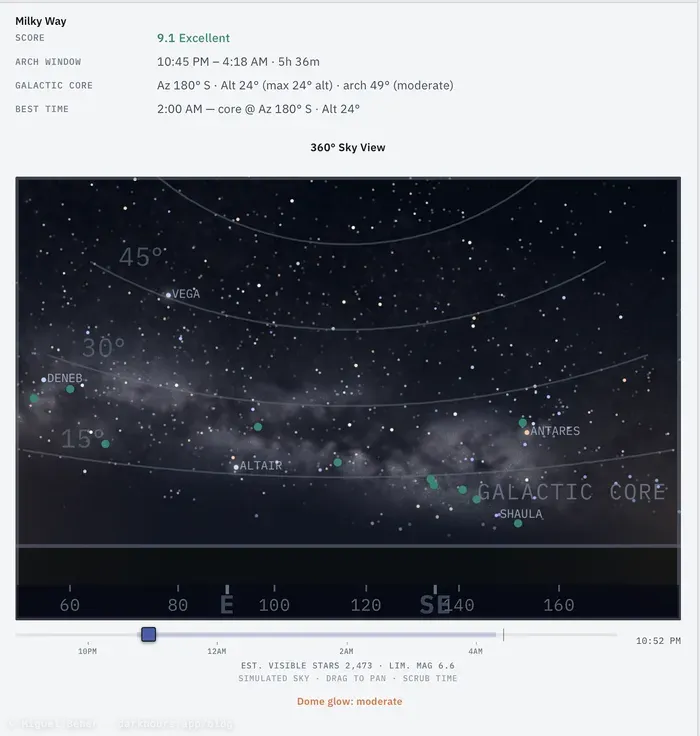
As beautiful as it was, I was quietly celebrating — my new app had not only predicted the moon, the weather, and the light pollution accurately, but nailed the Milky Way’s position at this exact time too. I’d built something I was proud of, and it was all working perfectly on it’s first field test.
We hung around for about 45 minutes and then decided to run the gauntlet from the east side of the park, where we were staying, through the Mount Carmel Tunnel and down to the main canyon via some very tight switchbacks.
When we arrived around 11:30 PM, we saw a few other folks already set up at the history museum. A retiree named Maria was next to us. She and her husband had driven to Vegas from Florida, and she scheduled a pit stop in Zion to do some astrophotography since the moon was favorable. She was very friendly. I genuinely enjoy talking to people while shooting. Being alone with just my wife in the quiet, dark wilderness can feel uncomfortable at times. The parking lot felt festive. Our view pointed straight to the Milky Way core rising over the Watchman. As I worked out the composition, I decided the view needed wider coverage, so I worked on capturing a panorama. I had to balance taking enough exposures of overlapping frames for image quality against alignment issues with the moving sky. The longer each exposure, the more time passes between panorama sections, and the harder it was to line up everything in post. I settled on 10 x 6 second exposures per segment, with 7 overlapping segments at about 20 degrees of pan between.
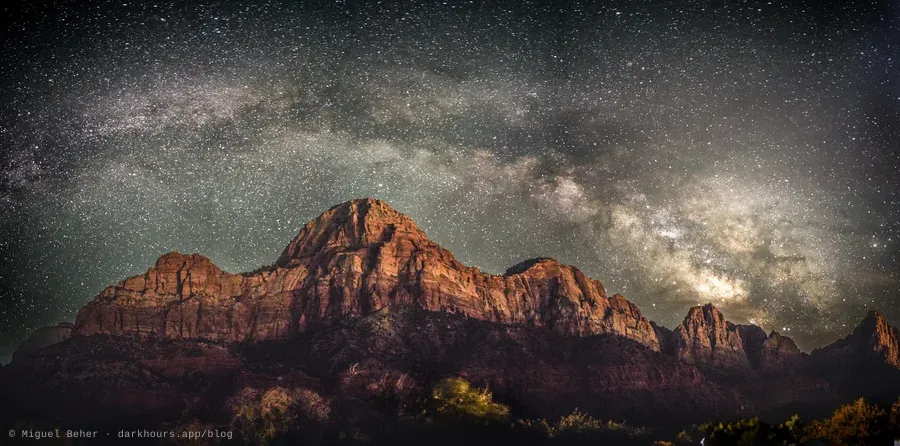
About 90 minutes in at the museum, the canyon’s winds started whipping up. Tripods began to wobble, and that was our cue to go to the next stop. A short drive about 3 minutes down the road took us to Canyon Junction. Despite how close it was to the museum, the pull off felt deserted and remote. There was no wind in this section of the park. The silence, combined with pitch-black mountains towering above us from the back and sides, felt unsettling. The view was worth it. Sometimes the universe lines up to show you something truly amazing, and you need to stop and look.
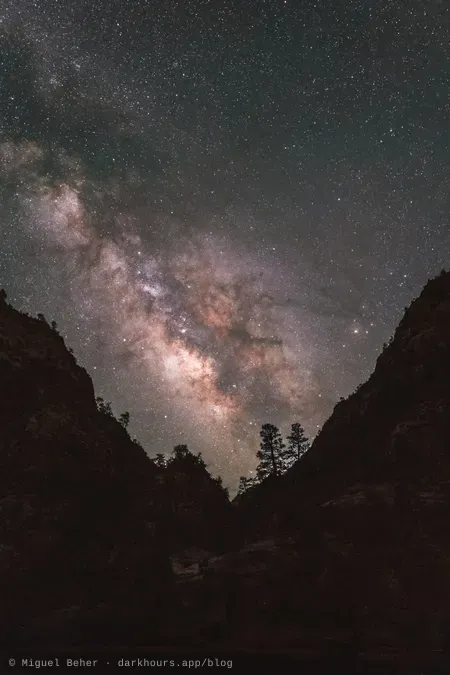
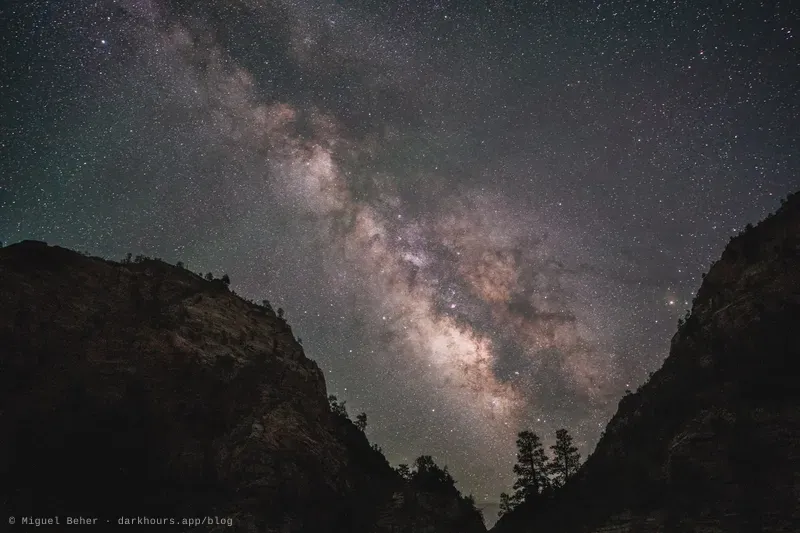
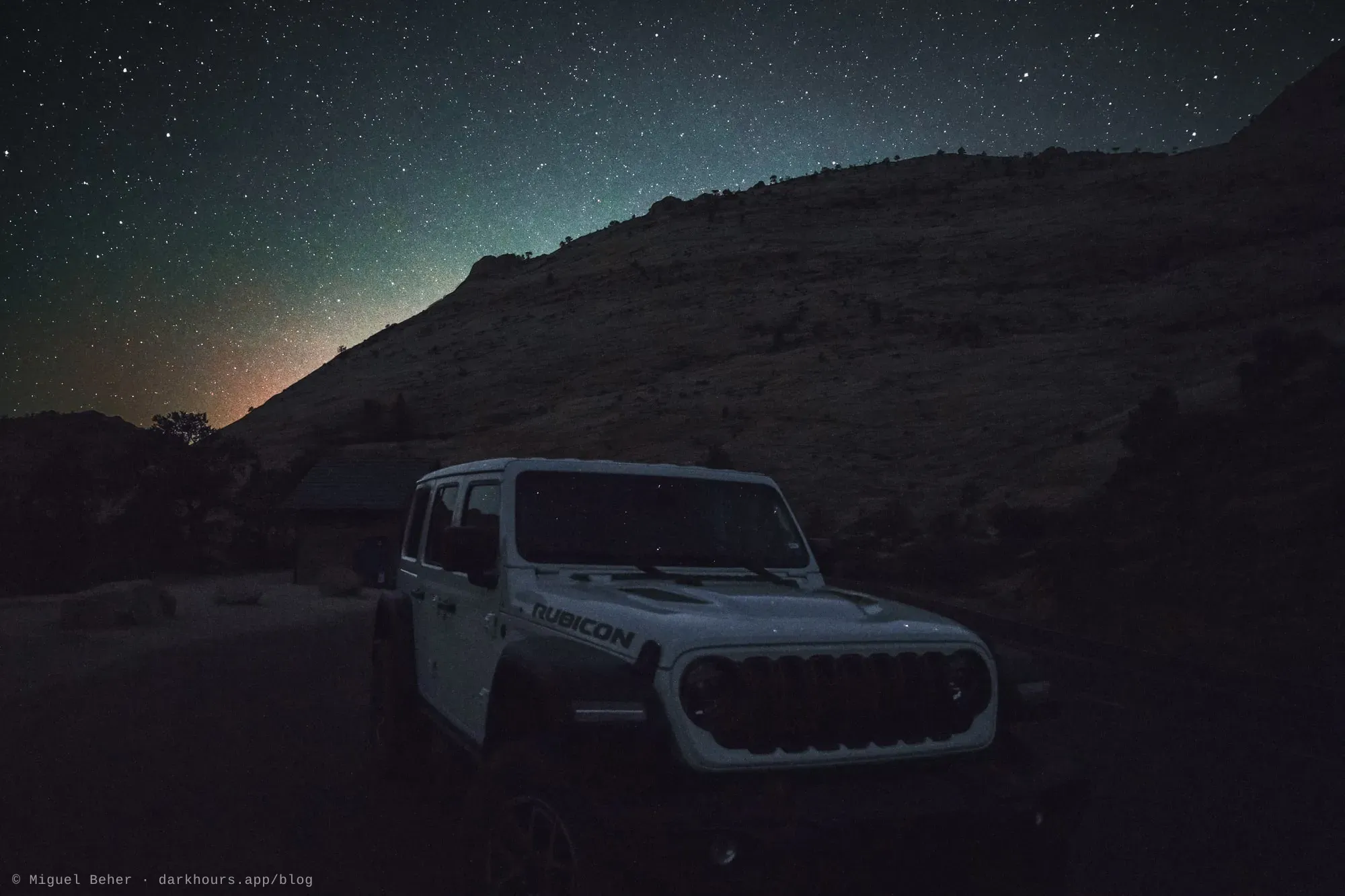
After a long day of travel, we were starting to fade. With some energy still in the tank, we started the drive back to the ranch. Before calling it a night, I checked out one more spot. The ranch’s reception building is situated on a pasture on the East Zion Plateau that has unobstructed views of the south. We pulled into the parking lot — set up the tripod and quickly got to work. While it’s not what you usually see from Zion, the area east of the park offers great skies.
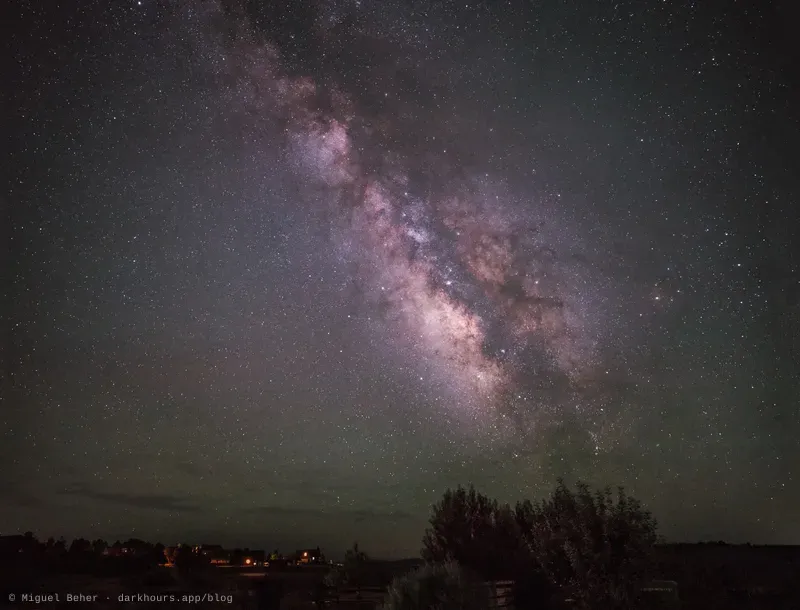
With our first night of astro done, we went to bed to get some much-needed sleep. Unfortunately, it would prove to be our only night with clear skies. Despite waking up under clear skies, all the weather forecasts began calling for 100% cloud cover for nearly all of southern Utah that evening. We held out hope that the unpredictable nature of the area would work out in our favor, so we spent the full day exploring Zion, cooling off in the Virgin River, and scouting locations.
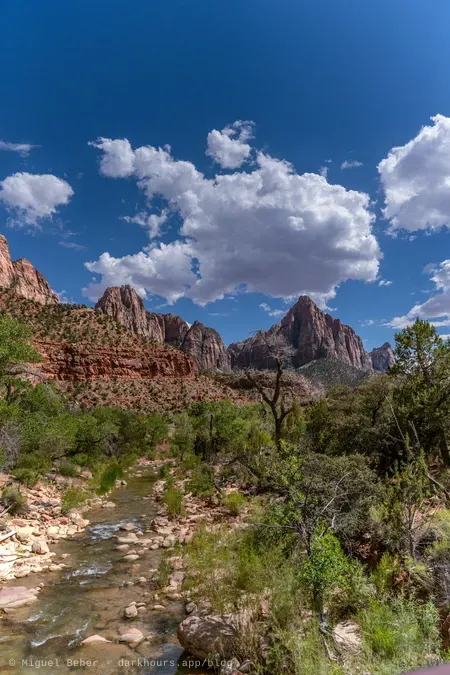
By the late afternoon, clouds started to roll in. Being clouded out did at least prove my app was pulling good weather data.
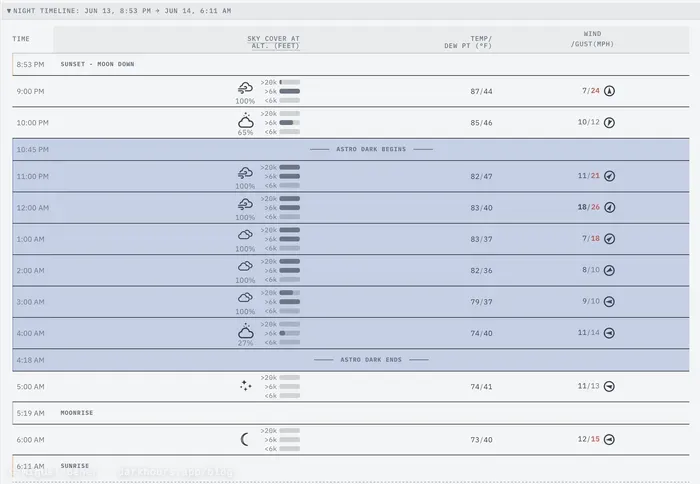
Outside was pitch-black — no moon, starlight, or light pollution bouncing off the clouds. We slept in the next morning before starting our journey home. Despite only having one night of shooting, this trip was a success. I would do it again. Nature puts on a good show. I’m here to witness it.